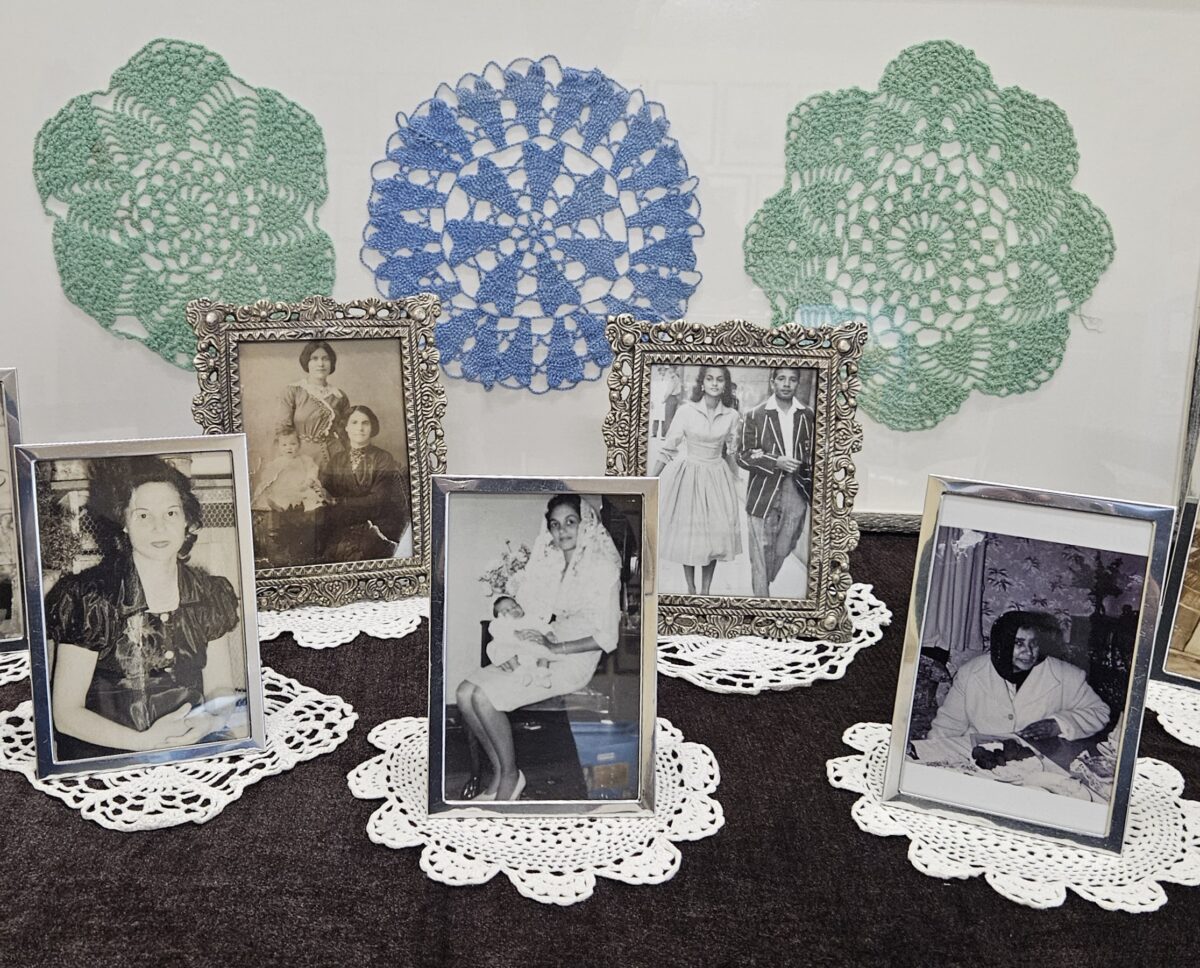
Our homes provide us with a cultural context that challenges ideas of how the oppressed lived. Like photographs, objects hold cultural memory, they connect us to each other and help us to tell our stories, as well as to remember the past and situate it in the present. I imagine the threads of my grandmother’s scarves and doilies wrapping themselves around the stalks and branches of the tumbleweed, a network of women’s histories, community memories and ways of healing concealed in its centre, patiently waiting for the right time to be resurrected. The simple objects are imbued with history, language and memory and hold the imprint of human touch and experience. They speak to centuries worth of cultural exchange. They beg to be examined more closely and ask us to bear witness to the stories that are contained within their interlaced networks. We dare not underestimate their narrative potential nor the important role they could play in the healing of our communities. The strands of threads and thoughts speak to connections through time and place, traversing oceans and deserts, blurring borders of race and religion. They offer us the opportunity to recognise ourselves in the other and urge us to write a different narrative of who we are and where we come from.
Extract: Fieldguides for a Preternaturalist: No. 1 Unpick, Restitch: Doilies, Medorahs and Labouring Plants
In my work over the last few years, I have been deeply touched by the many people who have felt comfortable sharing their stories with me. Invariably, someone from the audience I was addressing has come up to me afterwards to “just quickly tell me something” that happened to them, to an aunt, a grandmother, or a friend. Since one of my primary motivations to write has been to contribute to the conversations around heritage, identity and belonging, this has been infinitely rewarding. I feel an obligation to honour these stories.
An Archive of the Ordinary was born out of the need to archive and share the stories about objects, images, food, textiles and practices that both acknowledge the pain and trauma of our history and celebrate the humanity of the individuals who lived this history. The food our mothers prepared, the clothes they sewed or knitted, the plants they used to heal, the photographs they kept in biscuit tins, all contain stories of how we lived. An Archive of the Ordinary will provide a digital platform to record these ordinary stories as told by ordinary people and will include short anecdotes in the Gallery section, and longer pieces written for the Stories section. From time to time, in-person events will be held.
My intention is that the website will serve as a record of lived experiences and as an educational resource, and I hope to connect with work being done by others in similar fields. While the main focus of the project will be on South African stories, contributions from further afield will also be included to to inspire and support storytelling around an alternative archive.
An Archive of the Ordinary aims to disrupt the narrative that our stories don’t matter, and that we are a people without history.
Visit An Archive of the Ordinary
Featured Image taken at a talk about the women in my family for Women’s Month at the Simonstown Museum.


 Coming across this tradition in Walvis Bay, Namibia, speaks to the interconnectedness of its history with Cape Town. Walvis Bay became part of the British Cape Colony in 1878 and would be under South African control until 1994. Ruth Smith whose family came to Walvis Bay when she was a child (Walvis Bay: Our Story), also recalls that most fishermen came from South Africa. They would go out on small wooden boats or worked as supervisors in the fishing factories.