Categories
Book

A warm international welcome for Off-Centre and Out of Focus

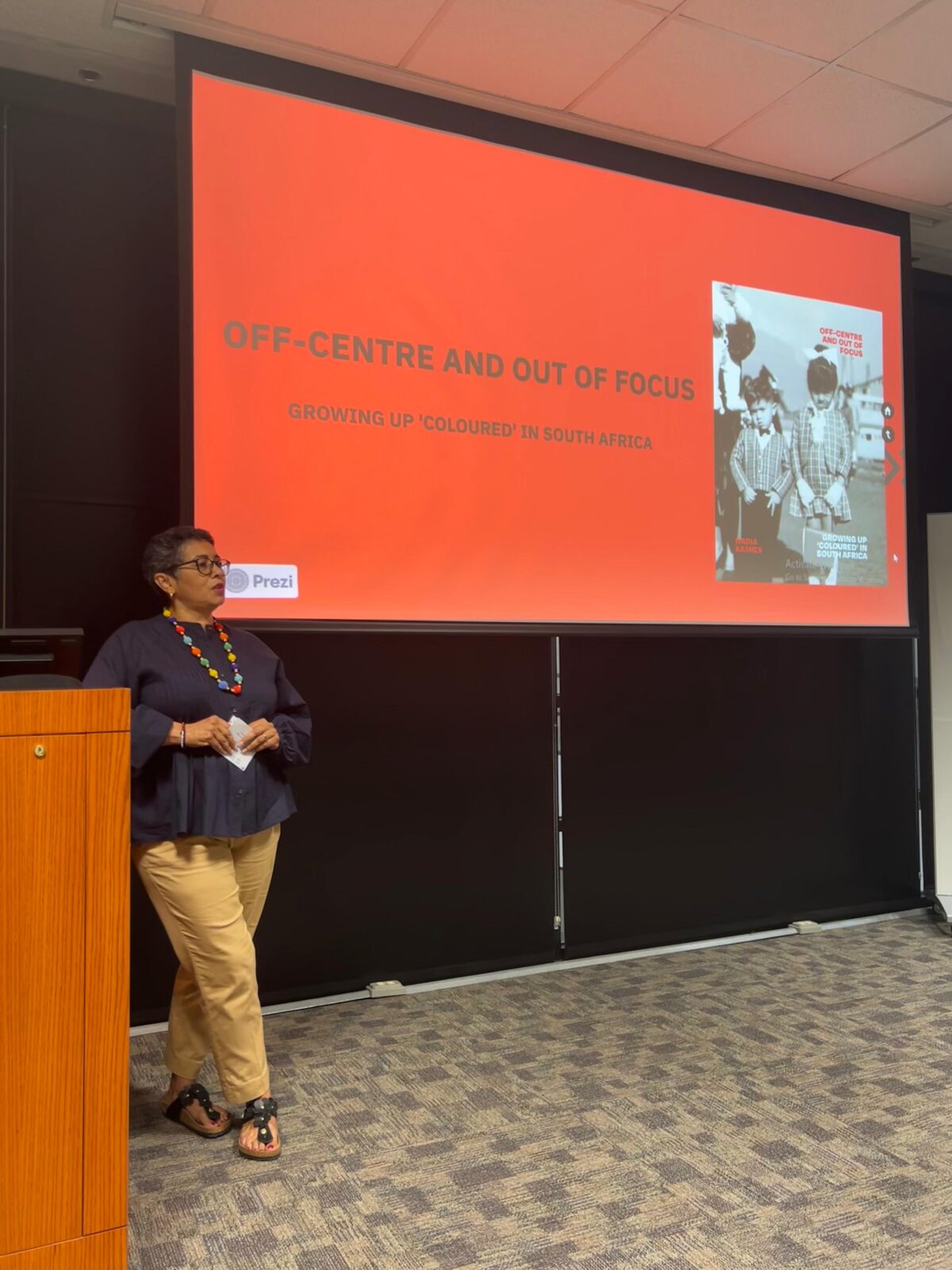
The last two weeks in London have been such an affirmation of the universality of our stories and of issues around identity, belonging and displacement. “Why launch in the UK?” is a question that I have been asked more than once.

One motivation was that, after speaking at Xavier University of New Orleans, and in Edinburgh and London a year ago, I wanted the book to be more easily available internationally. The other was the constant reminders of the rise of racism, hatred and bigotry, and how my experience of growing up in South Africa resonates with anyone who has grown up with institutional and entrenched discrimination. These themes are not limited to a single country.

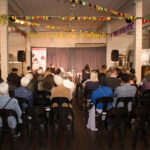
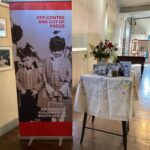
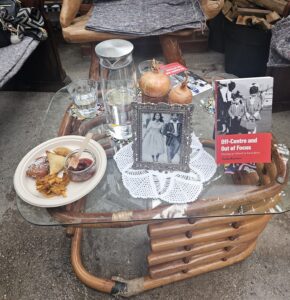
The London book launch attracted friends, friends of friends, and adopted family, to the green community space that is The Onion Garden. I have watched Jens Jakobsen over the last four years, change a patch of concrete into this little sanctuary in the centre of a busy metropolis and it felt like the right place to launch my little book into the world.

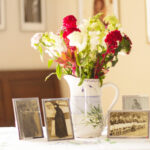
I brought my ancestors along in the form of my grandmother’s doilies, photographs of my parents and grandparents, and the food. Having searched for “Cape Town-style” samoosas and dhaltjies in vain, I serendipitously came across the Oitij-jo Collective a women’s collective that focuses on Bengali culture and arts… and there were the local treats I had grown up with.

Finding koesisters the way my grandmother made them, proved to be a bigger challenge. My grandmother made the fried doughnuts dipped in sugar syrup and rolled in coconut every week. When my father was young, he and his brothers would sell them door-to-door on Sunday mornings. So I rolled up my sleeves, donned the apron and made them myself!  I think my grandmother would have been pleased.
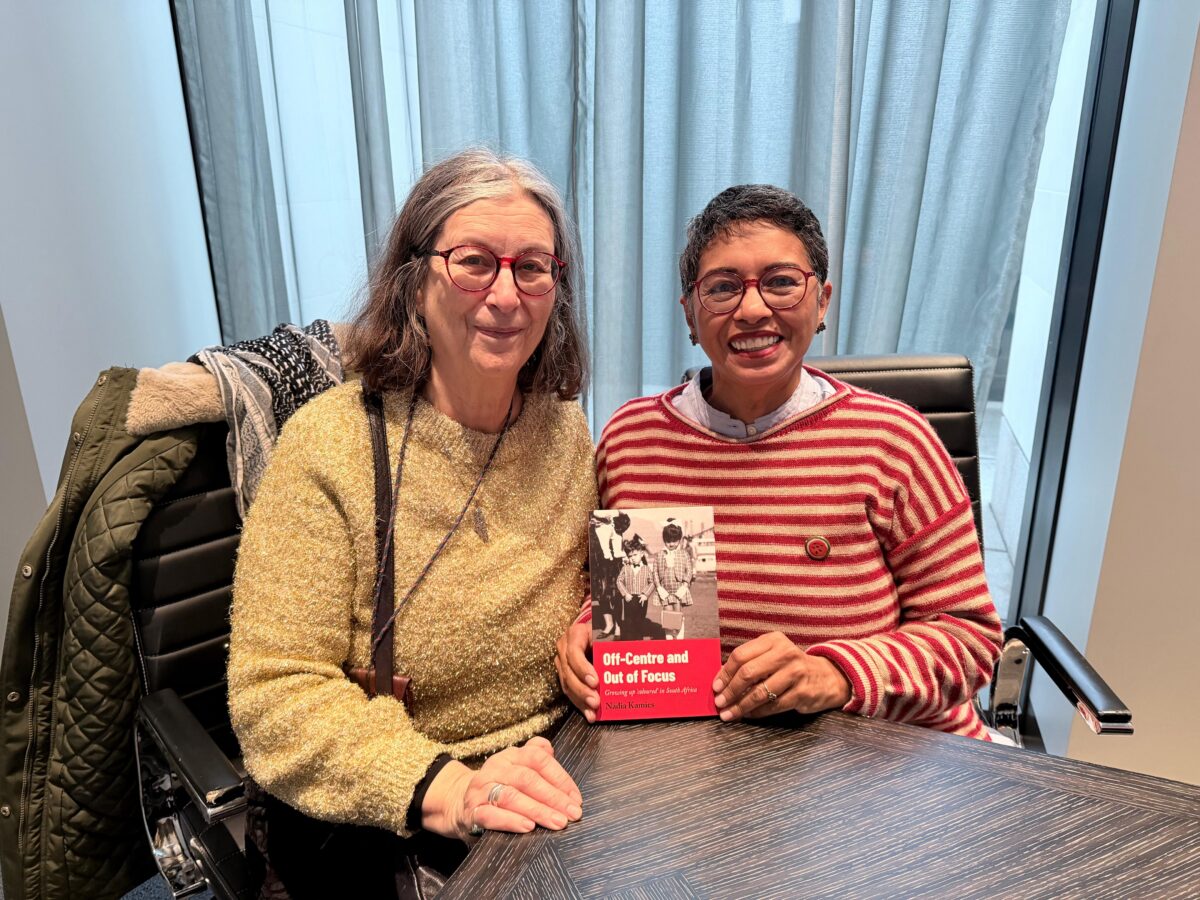
I have enjoyed conversations with Letitia George for BBC Radio Leicester, with Debbie Golt for Outerglobe on Resonance FM, and with Hannah Murray for Talk Radio Europe.

There have been a couple of written pieces, including How to Write a Memoir for Irish online writing magazine, Writing.ie., and an interview with USA-based  Authority Magazine.

Thank you for the warm welcome!

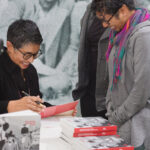
Featured image: With Debbie Golt of Outerglobe


Categories
Book

Off-Centre and Out of Focus for a new audience

My books and I arrived in London last week and I have been busily preparing for a relaunch on Saturday 7 February 2026 at The Onion Garden, a green community space in central London. Over the last four years, I have seen this space grow from a tiny business into an award-winning non-profit urban garden that brings community and nature together. A “welcoming space open to all for love, laughter and life” seemed just the place to relaunch my book across the ocean.

It has been a busy week that has included an interview with Letitia George on BBC’s Radio Leicester African Caribbean programme, an in-depth interview for an online platform in the USA, and a written piece on my memoir-writing process for an Irish website. I will share links to the latter when they are published. Here is the radio segment in the meantime.

With taking my book to an international audience, I realise anew the importance of being sensitive to how terminology related to race differs in other countries. The Note on Terminology in Off-Centre and Out of Focus reads as follows:

I believe that the concept of ‘colouredness’ is neither a biological nor an ethnic identity, but rather a result of apartheid social engineering. I reject this label and race as a concept, and consider myself a South African. The term ‘coloured’ refers to people of mixed descent, previously classified as such under the apartheid government. I am mindful that ‘coloured’ has different connotations in Britain and the United States of America, but my use of the word is specific to the South African context. Since it is impossible to move away from race markers in this discussion, I have chosen to write ‘coloured’, ‘black’ and ‘white’ with small letters and in single quotation marks. Under Steve Biko’s Black Consciousness movement, ‘black’ referred to all those oppressed under apartheid. I have used this term to refer to people of African descent and for all people not previously classified ‘white’ in South Africa.

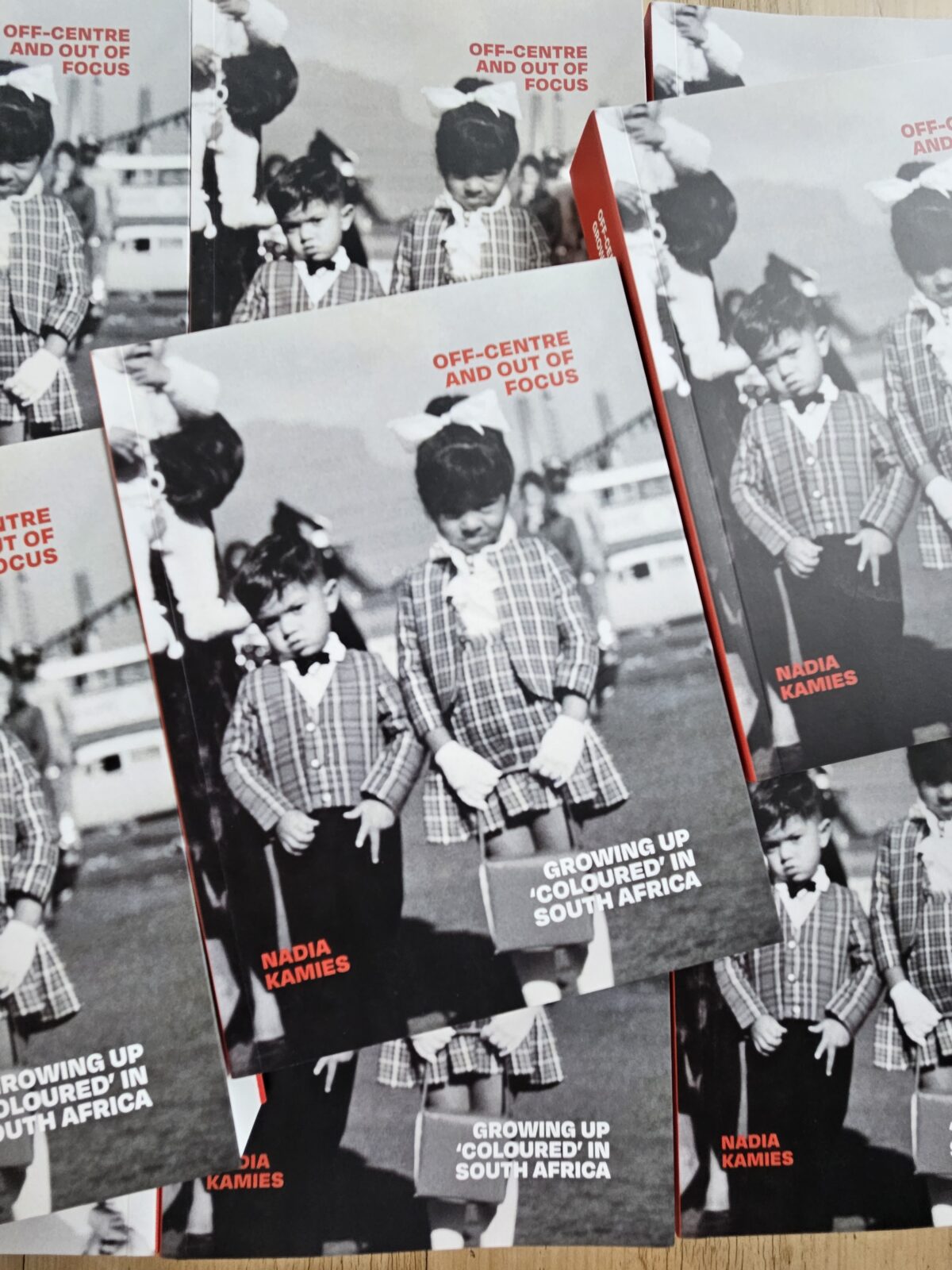
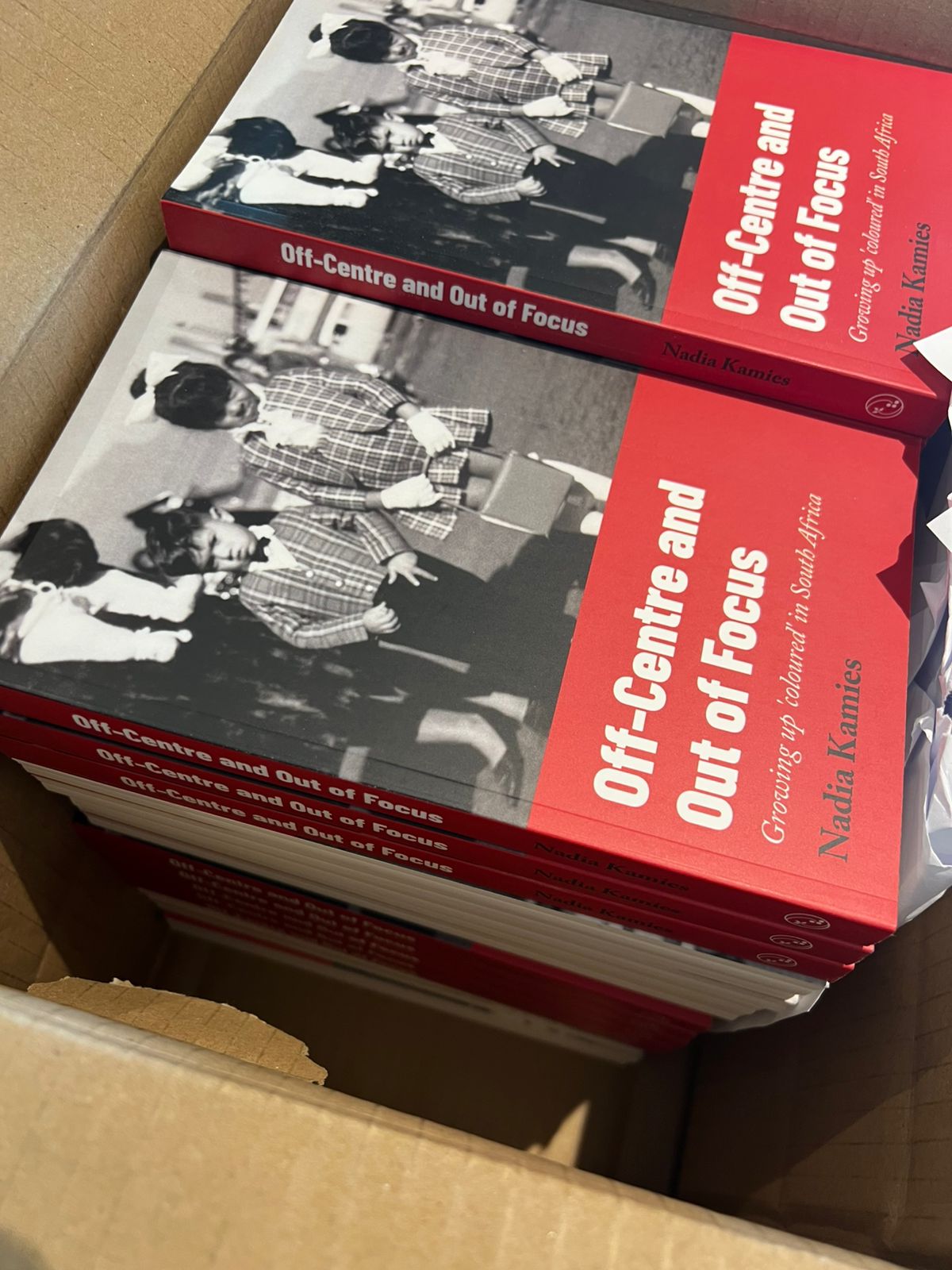
Off-Centre and Out of Focus: Growing up ‘coloured’ in South Africa
ISBN 978-1-83584-114-3
Published in the UK by Rowanvale Books
Available via Amazon and to order in all good bookshops

Categories
Book

Two Years of Off-Centre and Out of Focus

Off-Centre and Out of Focus was published two years ago this month. While the book launches and festivals have been fun, what has brought me the most joy has been the many conversations that have rippled out from my writing. I have met the most interesting and creative people and gone down unexpected paths.

Amongst these have been journeys to the Copper Mountains and across the Gariep River with Wendy Morris, and trips down memory lane in District Six and Walmer Estate with Ayesha Mukadam, the director of the documentary Restitching District Six. I have been in conversation with actor Bo Petersen about her autobiographical play, Pieces of Me, and with artist Marsi van de Heuvel about her exhibition, Skoonveld at the Cape Town Art Fair.

I have had the opportunity to exhibit my own family photographs and ceramics with Our Cape Town Heritage and explored some of the history of St James Beach with Multispecies Stories. I have spoken with midwives, doulahs and smeervroue in Cape Town and Paulshoek, and I have treasured every interaction with people who have come up to me at book events to share their own anecdotes about growing up in South Africa.

To those who ask about the next book – this one has been a life’s work and it seems it isn’t finished with me yet! I will be publishing Off-Centre and Out of Focus as a second edition in the UK in January 2026 with Rowanvale Books … watch this space for that book journey and other exciting projects on the way!

PS I have added the links to some of the people and projects and encourage you to check out the work that they are doing.

Featured image taken during an address to faculty members at Xavier University of New Orleans. November 2024.

Categories
Book

Starting Conversations

I was recently the guest author at the Woman Zone Book Club and I am enjoying the conversations that Off-Centre and Out of Focus is generating around identity, race and belonging. Most of all, I am simply enjoying the conversation!

The seemingly small hurts and humiliations that many of us suffered every day during apartheid, have not been spoken about. We are urged to get over apartheid and embrace the “rainbow nation”. Ignoring our experiences minimises the trauma that we lived through. Until we examine the past and make peace with it, we cannot move forward and learn to live together in a post-apartheid society as simply human. And we cannot afford to forgo the opportunity to do so while those who lived through that period are still alive to share their memories and experiences with us.

The words of American writer, musician and academic, Julius Lester (1939-2018), express so profoundly the importance of acknowledging the lived experiences of growing up in a marginalised and oppressed community. He says,

History is not just facts and events. History is also a pain in the heart and we repeat history until we are able to make another’s pain in the heart our own.

My book was always intended to be about starting conversations, about saying, “this is how it was for me, how was it for you?”

When we engage with each other in a sincere attempt to understand the other, it is possible that it will lead to a place beyond the stories of different cultures, beyond stereotypes and prejudices, to acknowledge and embrace our multiple stories. By connecting the lines between all of our stories, we may recognise our common humanity, we may break down the walls that were constructed around us to keep us separate. Perhaps it will lead to a fusion of ideas that may result in a new way of expression, a new story, and the acceptance of diverse points of view. Only then may we learn to be free.  Off-Centre and Out of Focus.

You can find Off-Centre and Out of Focus: Growing up ‘coloured’ in South Africa at The Book Lounge, Clarke’s Bookshop, Exclusives Books, Wordsworth Books, at the District Six Museum shop and online from Loot.co.za

You can listen to the Woman Zone Stories MEET THE AUTHOR podcast here.

Categories
Book

Off-Centre and Out of Focus is launched

Off-Centre and Out of Focus: Growing up ‘coloured’ in South Africa was launched with friends and family at the District Six Homecoming Centre on 13 May. It was wonderful to be able to celebrate with people who have been on the journey with me and who contributed to this book in some way – sharing their stories with me, cheering me on, and offering advice.

I was particularly pleased about being able to celebrate the birth of my book in the District Six Homecoming Centre in what used to be the Sacks Futeran building. For generations the Futeran family traded in clothing and textiles here, and the store was frequented by generations of seamstresses and tailors from District Six. I remember being dwarfed by bolts of fabric and riding the rickety lift with my parents to the second floor to buy anything from crockery to clothing. My father’s memories of District Six are at the heart of this book. Sadly, he died of COVID in 2020, but I know that he would have appreciated the choice of venue.

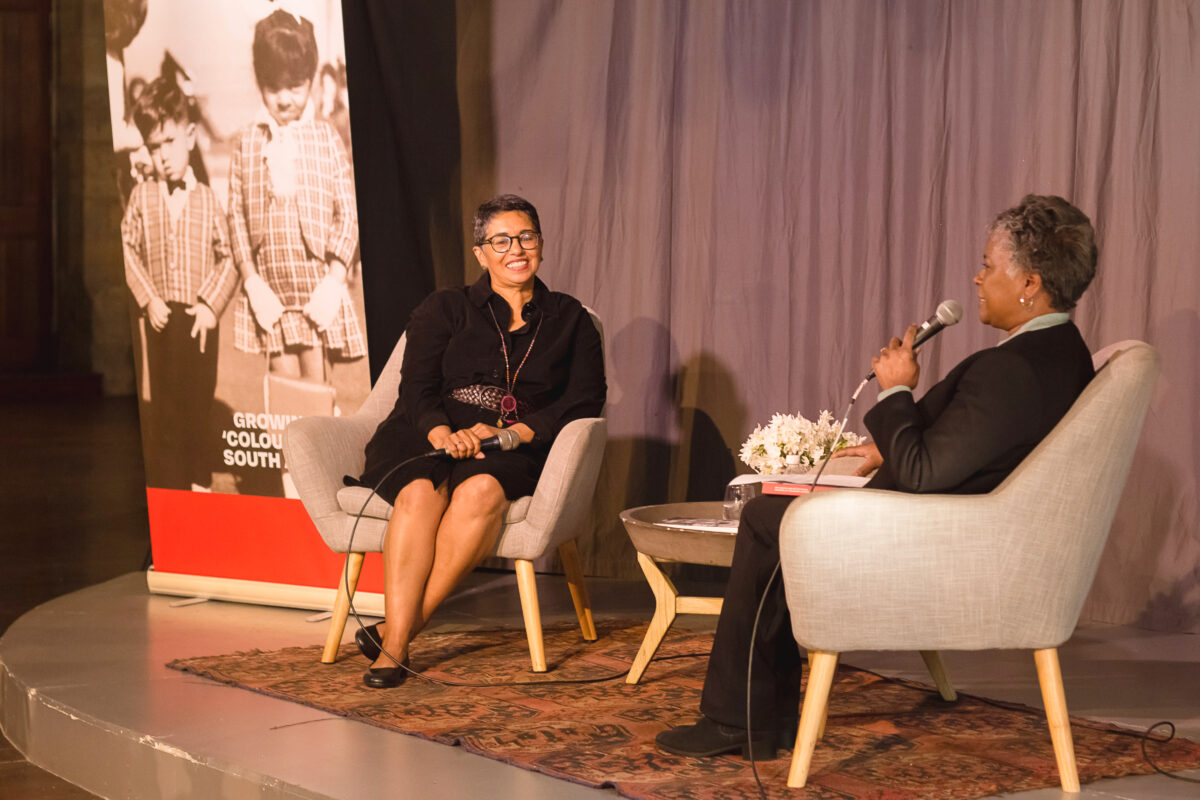
Dr Bonita Bennett, who was the director of the District Six Museum for more than ten years, gracefully facilitated a discussion around ‘colouredness’, the fluidity of race and belonging, issues of respectability, and the archiving of ordinary objects. This book has always been about starting a conversation about the complexities of growing up labelled ‘coloured’ in South Africa, before, during and post- apartheid. I wanted the knowledge that I gained during my PhD to be more widely accessible rather than being confined to the university library shelf.

The family photographs that gave rise to my thesis and now this book, represent the hopes and aspirations of our parents and grandparents. They generate stories of a way of being and living that challenge the dominant narratives of inferiority and shame that were assigned to a group of people designated neither-white-nor-black. They quietly disrupt the apartheid archive that sought to fix difference in terms of race, gender and culture. I hope that this will open up discussion around the pain and trauma that we lived through so that we may look forward to a future where we may see each other as simply human.

The American writer and activist, Audre Lorde, speaks about the importance of oppressed people being able to speak out of their own experience and to see it as valid, to deal with our definition of self. She cautions that if we don’t identify ourselves, someone else will, and probably to our detriment. Through sharing my experience, I sincerely hope that more people will be motivated to share theirs, and I look forward to more conversations and sharing.